

How To Reset Photoshop Cs3 Settings

Photoshop CS3 Essential Preference Settings
If you've just installed Photoshop CS3, whether yous've upgraded from an before version of Photoshop or this is your kickoff experience with the program, one of the first things y'all should practise is make sure y'all have everything set up properly in Photoshop's Preferences, which have been inverse quite a chip in CS3.
Yous may not find whatsoever options here that would, say, cause your figurer to explode if prepare incorrectly, but there are definitely some options that will help both you and Photoshop work more efficiently. We're not going to comprehend every unmarried preference, since your head would undoubtedly fall onto the keyboard before we made information technology to the end, merely we'll await at some of the more essential ones, the ones that give us the biggest blindside for the cadet. Or at least, they would if it actually, you know, toll something to make changes to the options, which it doesn't. Simply if information technology did, boy, these are the ones I'd be changing if I was looking to go my money's worth.
How To Access The Preferences
If you've been using a previous version of Photoshop, one of the things you'll notice with CS3 is that Adobe has reorganized and renamed some of the Preferences and even added a couple of brand new categories which we'll look at in a moment. Earlier we do though, nosotros need to know how to admission the Preferences. If you lot're on a Windows organisation, go upwards to the Edit Menu at the top of the screen, choose Preferences, and and so choose General. On a Mac, it'due south a picayune different. Rather than going upward to the Edit carte, go upwardly to the Photoshop menu instead, then cull Preferences, and so choose General. Or, an even faster mode to admission the Preferences is to use the keyboard shortcut, Ctrl+M (Win) / Control+K (Mac). Regardless of how yous get there, you'll be presented with the Photoshop Preferences dialog box, gear up to the "General" options:

Photoshop CS3's Preferences dialog box ready to the General options.
One difference to note right away between Photoshop CS3'southward Preferences dialog box and previous versions of it is that there is no longer a drop-down list at the top where y'all get to select the various categories. Instead, they're now all listed conveniently along the left-hand side:

The various categories are now listed along the left-hand side of the Preferences dialog box.
Since we already have the "General" Preferences open up, let'south start by looking at a few of import General options.
General Preferences: Paradigm Interpolation
In the Full general Preferences section, the first option we demand to look at is the second one from the top, Image Interpolation:

The "Image Interpolation" choice in the General Preferences.
"Prototype interpolation" has to exercise with how Photoshop handles the pixels in your images when y'all resize them. Photoshop CS3 comes with the aforementioned interpolation options that nosotros've had since version CS, so there's zippo new here, but information technology's important that we prepare this option correctly because it affects image quality.
The general dominion with the interpolation options is that we use Bicubic Sharper for reducing the size of an image, and Bicubic Smoother when enlarging images. At that place's besides another general rule though that says we never, ever enlarge images in Photoshop unless nosotros accept no other selection because enlarging images forces Photoshop to create new paradigm data out of thin air, which hardly e'er works out well. Then, since we'll be making our images smaller 99.99% of the fourth dimension, information technology's a good idea to fix our Image Interpolation option to Bicubic Sharper. Setting this option hither also affects other areas in Photoshop, like what happens when we ingather or transform images. So go ahead then and set this option to "Bicubic Sharper".
General Preferences: Automatically Launch Bridge
The next option worth looking at in the General Preferences is Automatically Launch Bridge:

The "Automatically Launch Span" option in the General Preferences.
This ane isn't quite as important as the Image Interpolation option we but looked at, and in fact it'southward really more of a personal preference, merely worth looking at anyhow. This pick determines whether or non Adobe Bridge will launch automatically when you open Photoshop CS3. If you observe that yous use Bridge a lot when working in Photoshop, plough this option on. Span unremarkably takes a few seconds to load, so if you take it launch with Photoshop instead of manually launching information technology later on, you won't have to sit there waiting for it. If, on the other hand, you don't find yourself using Span all that often, leave the choice unchecked.
General Preferences: Export Clipboard
Another selection definitely worth looking at in the General Preferences is Export Clipboard:

The "Consign Clipboard" pick in the Full general Preferences.
Unless y'all're in the habit of copying Photoshop files and pasting them into other programs, which is highly unlikely, turn this option off (uncheck it). Leaving information technology on will only wearisome your figurer downward for no practiced reason and may even throw upward a dainty little error message from fourth dimension to fourth dimension. No need for it.
General Preferences: Use Shift Key For Tool Switch
Another one of those personal preferences options is Apply Shift Key For Tool Switch:

The "Use Shift Key For Tool Switch" option in the General Preferences.
This option has to do with how you access tools in Photoshop's Tools palette which are hidden behind other tools. For instance, the Elliptical Marquee Tool is hidden by default behind the Rectangular Marquee Tool, yet both of them take a keyboard shortcut of Yard. With this option checked, you would admission the Elliptical Marquee Tool by belongings down the Shift fundamental and then pressing M. With the option unchecked, you lot'd merely press M twice, in one case for the Rectangular Marquee Tool and so once more for the Elliptical Marquee Tool. Perchance I'thou just lazy, merely having to add together the Shift central to the keyboard shortcut seems like an unnecessary step. I'd rather just press the alphabetic character twice, or three times depending on which tool I'm afterward. Your selection.
That covers the essential options in the General Preferences. At present allow's look at a make new category in Photoshop CS3 - the Interface.
Interface
Click on the Interface choice in the list of Preferences categories along the left to bring upward the new "Interface" options:

Photoshop CS3'southward new "Interface" Preferences category.
The "Interface" category may exist new to Photoshop CS3, simply many of the options here are not new at all. They've simply been moved here, and in some cases renamed, from other categories. The Show Channels In Color option, which you desire to leave unchecked, used to exist chosen "Color Channels in Color" and was found in the "Display & Cursors" category in previous versions of Photoshop. Show Bill of fare Colors and Bear witness Tool Tips were both previously found in the "Full general" category, along with Remember Palette Locations, which was previously chosen "Relieve Palette Locations".
The new pick at the top, Apply Grayscale Toolbar Icon, determines whether the "PS" icon at the top of the Tools palette appears in blueish or gray. Hither it is in blue, which is the default:

The 'PS' icon at the top of Photoshop's Tools palette appearing in its default blue color.
And here it is in gray:

The 'PS' icon at the acme of Photoshop'due south Tools palette actualization in greyness.
It may not seem like an important pick, merely I detect it helpful to set the icon'due south color to grayness so that the bluish color doesn't distract me when working on images. If you prefer to go out information technology blueish, simply go out this option unchecked.
If y'all're new to Photoshop, I'd propose leaving Show Tool Tips on. Tool Tips are those helpful little descriptions that appear whenever y'all hold your mouse over something for a 2d or two. Fifty-fifty if you've been using Photoshop for a while, I'd recommend leaving the Tool Tips on until yous become more than familiar with CS3, since the interface is quite different now than what we've been used to. Once you lot become more comfortable within Photoshop CS3, you lot can simply return to the Preferences and plough this option off.
You'll want to leave Retrieve Palette Locations checked. With information technology checked, the next fourth dimension you lot launch Photoshop, all of your palettes volition appear in the same locations every bit they were when you final closed out of the program. With it unchecked, the palettes will be reset to their default locations each fourth dimension you lot open the programme. You lot can always reset your palette locations any time you want by going up to the Window menu at the peak of the screen, choosing Workspace, and so choosing Default Workspace.
That covers everything new and/or important in the "Interface" category. Let'due south movement on to the side by side one, File Handling.
File Treatment
Click on the words "File Handling" in the listing along the left to bring up the options in the File Handling category. There'southward really simply 1 option here that nosotros need to look at for now - Maximize PSD and PSB File Compatibility:

The "File Handling" Preferences.
What "Maximize PSD and PSB File Compatibility" does is it saves a flattened version of your prototype inside your Photoshop document along with all of your layers. You lot need to take that flattened version included if yous're importing your files into, say, a folio layout program like InDesign or even a multimedia program like Wink. If you lot know that you're going to be importing your Photoshop files into other programs like that, go ahead and set this option to Ask, which volition cause Photoshop to ask you lot when you go to save the file if you desire to include that flattened version of the paradigm. The trouble is, that flattened version of the paradigm can increment the size of your file by every bit much as 30-50%, so if y'all take no intention of ever importing your files into some other awarding, in that location's no need to add to your file size, in which case I highly recommend you set this selection to Never.
In that location's a couple of options here that are new to Photoshop CS3 - Prefer Adobe Photographic camera Raw for JPEG Files and Prefer Adobe Photographic camera Raw for Supported Raw Files:
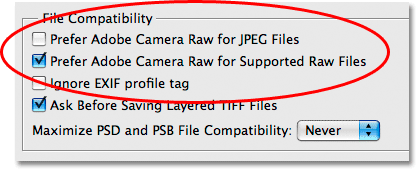
Photoshop CS3 includes two new "File Handling" options.
Photoshop CS3 allows us to open up both JPEG and TIFF files inside the Photographic camera Raw dialog box, but by default, this pick is turned off, and I'd suggest leaving it turned off for now because it's not quite every bit fun or straightforward equally it sounds. The second selection simply tells Photoshop to use Camera Raw for raw files, which makes sense and is turned on by default. I'd leave both of these options lonely for the time being, but just know that they're there and they're new to CS3.
Photoshop CS3 Essential Preferences: Functioning
Click on the Operation category on the left to bring up the new "Performance" options:

The new "Performance" Preferences category in Photoshop CS3.
As you tin can probably tell from the proper noun, this one has a lot to exercise with how well Photoshop performs. The "Performance" category in Photoshop CS3 is really a combination of the "Memory & Paradigm Cache" and "Plug-Ins & Scratch Disks" categories from previous versions of Photoshop. Information technology also now contains the "History States" option which used to be located in the "General" Preferences. Let's have a expect at each department separately, since they're all important.
Functioning Preferences: Memory Usage
The "Memory Usage" department is where we can gear up how much of our arrangement memory Photoshop is allowed to use:

The "Memory Usage" section in Photoshop CS3's "Performance" Preferences.
In Photoshop CS3 nosotros tin see an "Platonic Range" listed, which is the amount of memory that Adobe recommends we assign to Photoshop based on the corporeality of available system memory nosotros have. Photoshop automatically assigns an amount for itself based on that ideal range. Equally we tin come across in the screenshot in a higher place, it's giving itself 70% of my available retentivity. You can drag the slider bar left or right to increase or subtract the amount of memory available to Photoshop.
It may exist tempting to slide the bar all the manner to the right and hand over all your arrangement retention to Photoshop, only that'south non a adept thought. Continue in mind that at that place's other programs running on your estimator as well which all require arrangement retentivity. I'd recommend leaving this option alone. Chances are, yous won't find whatsoever huge performance benefits by giving more than retention to Photoshop, since you lot tin can never have enough organisation memory with Photoshop anyway. You're more probable to notice your estimator running slower because you've assigned Photoshop likewise much memory.
Operation Preferences: Scratch Disks
Below the "Memory Usage" section, we find the all-important Scratch Disks pick:

The "Scratch Disks" department in Photoshop CS3's "Performance" Preferences.
If at that place's one option in all of Photoshop's Preferences that has the biggest impact on functioning, it's this one. I mentioned a moment ago that you lot can never take enough system retentiveness with Photoshop. It volition ever need more retentiveness than what you lot take. So what does Photoshop practice when it runs out of system memory? It turns to the "scratch disk".
What's a scratch disk? It'southward an surface area on your estimator's hard bulldoze that Photoshop uses every bit memory. Unfortunately, hard drives are nowhere virtually as fast every bit system retention is, then yous'll definitely detect a functioning decrease whenever Photoshop has to use the scratch disk. There's no way around this, though. Such is life with Photoshop. All the same, decreased operation is better than the alternative, which is no operation. If Photoshop runs out of both organisation retention and scratch deejay space, you'll get an error message telling you that it tin can't do what you've asked because your scratch deejay isn't large enough. To make certain you never run across this problem, it'due south highly recommended that you purchase yourself a second hard drive and then assign that new bulldoze as Photoshop's scratch deejay, which you would do here in the Scratch Deejay options. You lot can partition your computer's original hard bulldoze and then assign one of the partitions as your scratch disk, merely even that isn't platonic. Your best bet for maximizing Photoshop's performance is to take a second difficult drive installed in your estimator and assign it as your scratch disk.
Performance Preferences: History States
Over in the top right corner of the Operation options, you'll find the History States pick:

The "History States" option in Photoshop CS3's "Performance" Preferences.
This selection determines how many undo'southward y'all get when working in Photoshop, which you tin see in the "History" palette. I ordinarily set mine to l, which allows me to step back through my last 50 steps. Yous can fix information technology up to a maximum of 1000 if you similar, but you'll most probable run into functioning problems if yous do. I'd recommend setting your History States to somewhere betwixt 25-l depending on how much system memory you have. If you observe you demand more and you oasis't noticed whatever functioning bug, yous can ever come back here and increase it. Besides, if you're noticing some performance problems, you can come up dorsum and attempt a lower amount. Y'all'll need to close out of Photoshop and relaunch it for the changes to be applied.
That takes care of our look at the essential options in the Performance Preferences. In that location's merely a couple more options we need to await at, and the start 1 is in the Cursors category, which is where we're headed next.
Cursors
Click on the Cursors category on the left to bring up the "Cursors" options:

The "Cursors" Preferences category in Photoshop CS3.
The "Cursors" category in Photoshop CS3 used to be called "Brandish & Cursors" in previous versions of Photoshop, but other than the slight name change, the options are mostly the same. As nosotros already saw, the old "Color Channels in Color" option has now been moved to the "Interface" category and renamed "Show Channels in Colour", and Adobe has removed the "Use Pixel Doubling" option completely in CS3, since no one knew what information technology was for anyway.
We won't notice any options here that will touch on performance, just there is one pick we should look at, Prove Crosshair in Brush Tip, along with the two options straight to a higher place it, Normal Castor Tip and Full Size Brush Tip. I like to have "Testify Crosshair in Brush Tip" turned on because it tells Photoshop to brandish a small crosshair icon directly in the center of my brush as I'thousand painting and so I always know exactly where the eye of my brush is, and I'd recommend you turn information technology on as well.
Equally for the two options above it, it's actually a personal option. With "Full Size Brush Tip" selected, Photoshop will make the brush cursor the total size of the brush then y'all tin see exactly how large your brush is, regardless of whether y'all're using a difficult-edge or soft-border brush. With "Normal Brush Tip" selected, which is what I adopt, if you're using a soft-edge brush, Photoshop reduces the size of the brush cursor to include only the areas where the pixel opacity is 50% or higher, which means the edges of the brush will extend out across the size of the brush cursor. Again, it's really a personal preference. Regardless of which type of castor tip you apply though, I'd definitely recommend turning "Bear witness Crosshair in Brush Tip" on.
At that place'south just one more Preferences category we need to await at - Units & Rulers.
Units & Rulers
Click on the Units & Rulers category on the left to bring up the "Units & Rulers" options:

The "Units & Rulers" category in Photoshop CS3's Preferences.
The "Units & Rulers" category has been effectually for a long time in Photoshop, and yet every fourth dimension a new version of Photoshop comes out, one pick is e'er set incorrect, and that's the one at the very pinnacle, Rulers. Set your rulers to use pixels, non inches, centimeters, or anything else. Photoshop is a pixel-based programme. Everything inside Photoshop deals with pixels. There'due south a time and a place for worrying nigh how big your epitome volition print in inches, and this isn't it, so brand sure you lot set up your rulers to use pixels.
Where to go next...
And that wraps upward our look at the essential Preferences settings in Photoshop CS3! Patently, in that location's quite a few options we didn't look at, but none of them are worth worrying virtually. Nosotros covered the ones that have the greatest impact on Photoshop's performance and on our ability to work efficiently within the program.
When y'all're washed making your changes to the Preferences, make sure you close out of Photoshop and then relaunch it for your changes to take result. Visit our Photoshop Basics department for more tutorials on the basics of Photoshop!
Other Stuff
© 2022 Photoshop Essentials.com.
For inspiration, non duplication.
Site design by Steve Patterson.
Photoshop is a trademark of Adobe Systems Inc.

How To Reset Photoshop Cs3 Settings,
Source: https://www.photoshopessentials.com/basics/preferences-cs3/
Posted by: wrightellonly.blogspot.com
0 Response to "How To Reset Photoshop Cs3 Settings"
Post a Comment